


The past five years of the labor market have been chaotic. You’ve seen the headlines: “labor shortage,” “hiring crisis,” take your pick. BLS’s 2024-2034 projections tell a more complex story: the labor force will grow, but the participation rate will decline. I say “complex,” because a declining participation rate isn’t actually the crisis it sounds like. It’s a reshuffling of who makes up the workforce. This “demographic squeeze” is an opportunity for correction, not panic.
Demographic Squeeze
What is a demographic squeeze? Simply put, the pool of available workers is shifting shape faster than employers have adapted to it.
Fewer young workers are entering the workforce, a nearly 10% decline by 2034 and a sharp pivot from the 2.3% increase from 2014-2024. Meanwhile, older workers are pushing off retirement, opting to work longer. Workers 55+ are projected to account for almost a quarter of the workforce, with workers 75+ growing a whopping 70%.
Immigration, historically a major source of labor force growth, has slowed sharply, driven by stricter enforcement and reduced legal pathways. Caregiving demands are also pulling workers, primarily women, out of the workforce. And people with disabilities remain disproportionately underemployed, facing an unemployment rate double that of non-disabled workers.
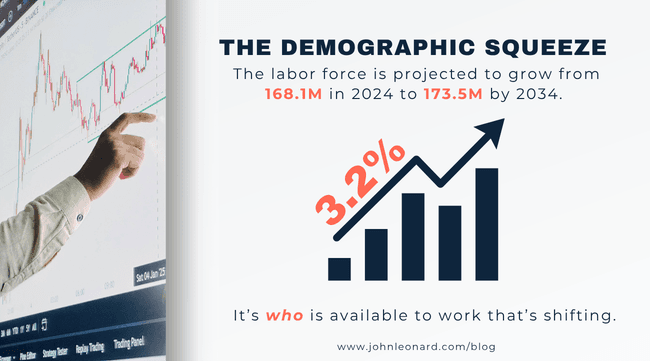
This demographic squeeze is not a downturn. In fact, the labor force is still growing, from 168.1 million in 2024 to a projected 173.5 million by 2034. It’s the composition of who’s available to work that’s changing, not shrinking.
Emerging Talent Pools
Workers aren’t disappearing. They’ve been here the whole time; many were just overlooked. For years, degree requirements and narrow experience filters kept qualified candidates screened out. Now, tighter hiring is pushing employers to drop those requirements and look at transferable skills instead, casting a wider net.
That same shift is opening doors for talent pools that have long struggled to find and keep steady work. People with disabilities remain significantly underemployed. Just 22.8% were employed in 2025, compared to 65.2% of people without a disability. Caregivers face a similar gap: the labor force participation rate for mothers with young children dropped from 69.7% to 66.9% between January and June 2025 alone, driven in large part by return-to-office mandates and reduced remote work flexibility. Remote, telework, and flexible arrangements are the specific tool that’s proven to keep both groups employed.
Older workers delaying retirement tell a similar story. Rather than blocking younger workers from entering the workforce, this cohort brings extensive institutional knowledge and a growing openness to part-time, consulting, or phased-retirement arrangements. That flexibility makes for smoother, higher-quality transitions between established and incoming workers.
The Shift
A labor market squeeze gives employees and job seekers greater leverage: more opportunities, more flexibility, better pay. Instead of waiting for the “unicorn hire,” employers are dropping rigid job requirements, hiring for skills, and investing in training. Holding out for a candidate who checks every box does the organization more harm than good. To be clear, this shift isn’t happening out of generosity; the market is forcing employers to adapt.
Employer Actions
Adapting to this squeeze is necessary, and there are three easy, concrete actions to ensure you’re staying ahead of the game:
- Widen your talent pool – Focus less on degree requirements and rigid experience expectations. Look at transferable skills and alternative credentials, especially where different experiences can bring greater creativity.
- Be flexible – Wherever the role allows, build in flexibility. Consider remote and hybrid options, varying start and end times, microshifting, reduced hours, etc.
- Invest in training – Instead of waiting for the “unicorn,” leverage training opportunities.
Engaging a staffing partner, like JOHNLEONARD, can help you ease into this practice. Identifying quality talent with the skills matched for your organization’s needs, advising best practices for a successful hire, and providing insights on market behavior is exactly what we’re built to do.
The workforce is not shrinking; it’s shifting. Employers who pay attention and adapt quickly will come out on top. Don’t wait for the market to return to “normal.” This is the new normal, and it’s time to act.