

Workplace words and phrases have dominated labor market conversations since the pandemic. From “The Great Resignation” to “Job-Hugging,” new job market buzzwords are popping up daily. Staying on top of these trends can be just as confusing as trying to figure out what “six seven” means. However confusing they may be, they’re incredibly insightful in defining the relationship between employers and employees and navigating the job market.
To best position yourself in this market, whether you’re hiring or job searching, understanding the language shaping today’s workplace gives you a critical edge. It allows you to better interpret market trends, empathize with the challenges on the other side of the table, and position yourself with intention and strategy. We hope this article brings clarity and empowers you to turn obstacles into opportunities.
AI Limbo
The widening gap between employee expectations and organizational implementation of AI. As Workers are eager to elevate their skills and productivity, many organizations are lagging in responsible policy development, compliance, and training.
Anti-Perks
Workplace conditions that detract from the employee experience, including micromanagement, unrealistic expectations, and outdated practices, policies, or structures.
Bare-Minimum Mondays
A practice that counters the pressure of constant overproductivity by encouraging employees to prioritize self-care and ease into the week with a slower start. By setting boundaries and focusing on balance, workers reclaim control of their work-life rhythm.
Boomerang Employee
Someone who leaves an organization on good terms and is later rehired. The benefits of boomerang employees include reduced recruiting costs, faster onboarding, more predictable performance, and a strengthened employer brand.
Boreout
A sense of uselessness and diminished motivation at work. Many who reach this level of burnout can regain momentum by learning new skills, embracing new challenges, or stepping into a new role.
Career Catfishing
Accepting a job offer, then never showing up for work without communicating with the employer. A recent survey revealed that 34% of Gen Zers, 24% of Millennials, 11% of Gen Xers, and 7% of Boomers admitted to career catfishing.
Career Cushioning
In response to economic uncertainties, career cushioners take skills development into their own hands while casually job searching in case they’re victims of layoffs. Think of it as a job security backup plan.
Coffee Badging
Hybrid employees who come to the office for a cup of coffee or a meeting, then return home to work. As return-to-office mandates rise, coffee badging is a creative way to interact with coworkers and meet the in-office requirement while maintaining flexibility.
Ghost Jobs
Jobs posted on career pages and job boards that employers have no intention of filling. They may be outdated listings that were never removed or strategic posts used to gauge interest and collect resumes. Either way, ghost jobs waste valuable time, clutter job boards, mislead candidates, and are not a good practice for responsible hiring.
Ghost Vacation
Taking unauthorized time off from work without telling anyone. A 2025 survey found that 1 in 3 U.S. employees have taken at least 1 ghost vacation in their career.
Great Flattening
A workforce reduction tactic that specifically targets middle management in an effort to reduce costs and increase efficiency within organizations that are financially struggling.
Job Crafting
A strategy where employees and managers collaborate to refine and reshape a role around the employee’s strengths, skills, and long-term career goals, often serving as a practical alternative to a more drastic career pivot.
Job Cuffing
An overcommitment to the job in times of uncertainty, with a goal of increasing job stability and security. While job cuffing can boost productivity, it also often leads to burnout.
Low-Hire, Low-Fire
A period where turnover is, for the most part, stalled. Employees aren’t quitting, and employers aren’t laying off, so fewer roles are open and available to job seekers.
Micro-Retirement
A sabbatical or leave of absence to prioritize health and well-being. Most micro-retirees will explore hobbies, travel, or just take time to relax and restore.
Microshifting
A restructured work style that breaks the day into 60–90 minute focus sprints, maximizing productivity during peak energy hours while preserving flexibility for life outside of work.
New-collar job
An in-between of blue and white-collar jobs that requires technical skills, but not a college degree. Most of the skills needed for new-collar jobs can be learned on the job, through a certification program, or in a vocational school.
Office Frogs
A term describing Gen Z employees who “hop” from job to job. While many job seekers change jobs frequently to gain skills and experience and find the right path, switching jobs too often can be a red flag to prospective employers.
Poly-Employment or Poly-Working
Workers who take on multiple roles at once. The goal is to achieve financial security, explore different career paths, and/or build diverse industry experience and skill sets.
Spamplications
Using AI to send hundreds of job applications at one time. Many job seekers do this to hopefully increase their chances of landing an interview. Commonly referred to as ‘resume spamming’, this practice can backfire more often than succeed.
Workslop
Poor-quality work generated by AI that ends up costing everyone valuable time rather than saving it. To avoid workslop, ensure AI prompts are detailed and thorough, and all responses are fact-checked, proofread, and edited.
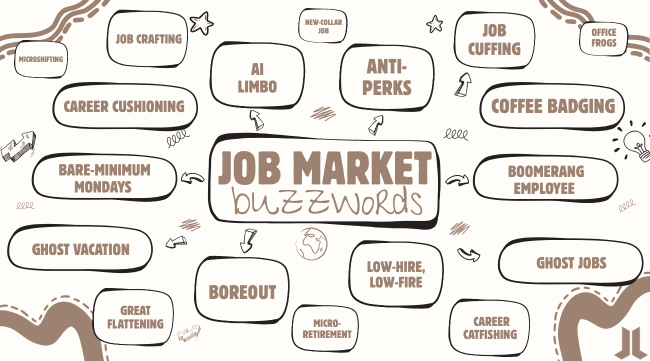
Behind every trending term is a real workplace shift. By understanding the language driving today’s job market, you gain the clarity and confidence to adapt, compete, and succeed.
Hiring top talent or searching for your dream job? Connect with a Staffing Consultant today!