
Growing up, mental health wasn’t something openly discussed. Mental health disorders run in my family. For years, many have suffered quietly because it was considered shameful. Back then, admitting you were struggling meant risking judgment or rejection.
Today, the stigma has eased, but the problem has only grown. We’re living through a mental-health crisis that touches nearly every family, workplace, and community. Employers, as leaders, can create an open, safe, and comfortable environment for employees to thrive.
The Scope of the Crisis
According to the National Institute of Mental Health, roughly one in four adults in the U.S., about 59 million people, live with a mental illness. The CDC reports that many adults regularly experience anxiety, depression, or both. These challenges don’t stay at home when people come to work; they affect focus, productivity, and relationships.
Mental health issues aren’t uncommon. They’re universal. And employers who fail to acknowledge that reality risk more than lost productivity; they risk losing their people.
Employers Must Recognize and Validate
For too long, mental health was treated as a “personal issue.” But it’s a real, measurable workplace concern. Recognition starts with validation: understanding that mental illness is not weakness. It’s health.
Leaders set the tone. When managers and executives talk openly about stress, therapy, or taking mental-health days, they normalize what used to be stigmatized. Policies matter, but culture matters just as much.
How Employers Can Support Employees
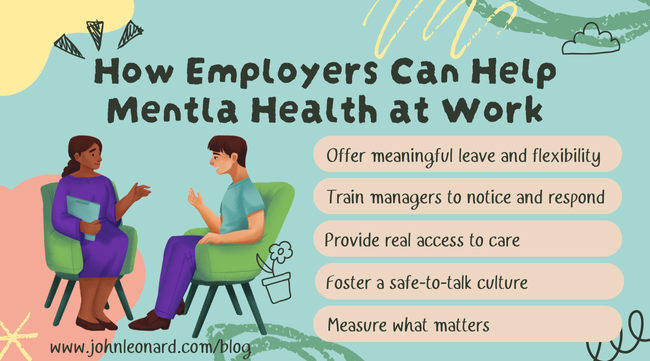
- Offer meaningful leave and flexibility.
When I was hired over 30 years ago, long before “mental-health days” were a thing, my employer offered 12 sick/mental-health days each year. That simple gesture said, “We see you as a whole person.” It made space for recovery without fear of judgment. Today, flexibility can mean hybrid schedules, reduced workloads during tough periods, or phased returns after medical leave. It costs little but sends a powerful message of trust and respect. - Train managers to notice and respond.
Supervisors are often the first to see signs of distress: withdrawal, irritability, or burnout. Equip them with basic skills: how to start a compassionate conversation, when to refer to HR or an Employee Assistance Program, and how to follow up without prying. - Provide real access to care.
An Employee Assistance Program (EAP), mental-health coverage in insurance, or a list of affordable community resources can make all the difference. But these types of support must be visible and encouraged, not buried in fine print. - Foster a safe-to-talk culture.
Encourage openness without pressure. Celebrate Mental Health Awareness Month, share stories, or hold well-being check-ins. Most importantly, treat mental-health absences exactly like physical-health ones without stigma or gossip. - Measure what matters.
Track absenteeism, turnover, and engagement. Listen to employee surveys. If people are burning out or afraid to speak up, the culture needs work. Data can show where to start.
The Difference Compassion Makes
Those 12 sick/mental-health days I was offered early in my career weren’t revolutionary on paper, but they were transformative in practice. They showed me that I could take care of myself and still be valued. That mindset built loyalty, trust, and genuine commitment to my employer.
That’s what real support does. It creates workplaces where people can show up fully, healthy, authentic, and capable of their best work.
Final Thoughts
Mental health touches all of us, at home, in our families, and at work. Employers can’t fix every struggle, but they can create environments that help people heal and thrive.
Recognize that mental health is real. Validate it. Build flexibility and compassion into your policies and culture. Because when we take care of our employees’ mental health, we’re not just helping them, we’re strengthening our entire workplace community.
Don’t forget to subscribe to The JOHNLEONARD Blog!