

Finding a job is hard. We get it, and we feel for you! As recruiters, we want to help you be as productive and successful as possible in your job search, starting with why “spray and pray” is quietly killing your results.
“Spray and pray” is thoughtlessly sending your resume to tens or hundreds of job openings, hoping one will stick. This method decreases your chances of landing a job, and it contributes to clogged candidate pipelines and overwhelmed recruiters and hiring managers. Whether you apply manually or use AI, “spray and pray” is not a viable tactic. In fact, it’s adversely affecting your job search.
There absolutely is validity in applying for roles you don’t 100% qualify for, but that strategy is nuanced. Part of the problem is two-fold: many hiring managers are using AI to screen resumes, and many job seekers are using AI to apply. More generic applications mean more automated filtering, which increases the chance that qualified candidates go unnoticed, causing them to send out even more resumes. And the cycle continues.
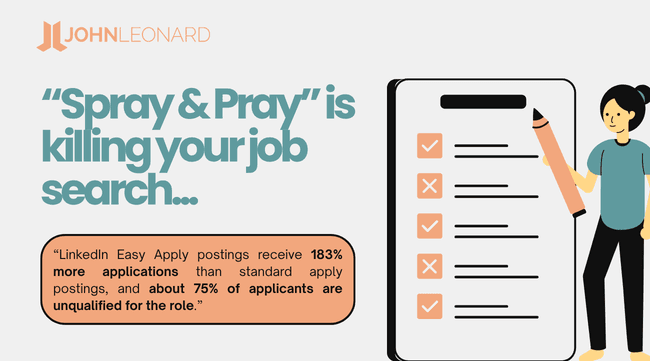
In a single circumstance, this might not seem like such a big deal. Zoom out, and the picture gets ugly: LinkedIn Easy Apply postings receive 183% more applications than standard apply postings, and about 75% of applicants are unqualified for the role. Mass-applying only feeds this inflation.
JOHNLEONARD Staffing Manager Elyse Gonsalves puts it plainly: “When someone consistently applies for jobs they’re clearly unqualified for, it makes me question their self-awareness of where they stand in the market.”
Why This Method Should Be Avoided
Recruiters report receiving double the applications, with lower quality overall. A Gem 2025 report found recruiter workloads have increased 56% in recent years. Imagine trying to evaluate 250 applications for one job opening, three-quarters of which don’t qualify for the position, while responding individually to everyone. It’s physically impossible.
If you’re not targeting the right roles and tailoring your resume, you’ll be passed over quickly. Mass-applying to roles you don’t qualify for only adds to the bandwidth problem recruiters and hiring managers are already fighting. You’re not just wasting your own time; you’re wasting theirs, and other job seekers’, too.
The odds get worse, not better, the more you spray and pray. Data from the US Bureau of Labor Statistics shows that sending 21–80 applications has a 31% chance of receiving a job offer. More than 80 applications, that probability drops 11 percentage points to 20%. Not an encouraging statistic.
Re-strategize Your Search
Whether you’re applying on autopilot or using AI to apply in bulk, the first step is breaking the mass-apply habit. Slowing down and spending more time on each application feels counterproductive, but it will improve your outcomes. In his recent article, Senior Consultant Christopher Wallingford recommends applying smarter, not more:
- Apply to 10–15 highly relevant positions each week
- Customize your application where it matters
- Write a thoughtful cover letter when appropriate
- Follow up on each application
We also recognize that urgency is real. If you need to make a quick call on whether to apply, Consultant Jake Balderston recommends weighing three factors:
- Location & Hours: Does the commute work for me and my life?
- Compensation: Does this give me what I need to provide for those I’m responsible for?
- Key Job Functions: Do I have the skills/experience, and can I see myself doing this for the foreseeable future?
When NOT to Apply
The greatest waste of your time, and everyone else’s, is applying for jobs way out of your scope. There’s absolutely a case for applying when you’re underqualified; that’s not the same as applying when you’re not qualified.
- Specialized licenses and credentials (lawyers, doctors, engineers): if the role requires an advanced degree, license, or credential you don’t have, don’t apply.
- Technical skills/experience (accountant, IT, architect): unless it’s entry-level with on-the-job training explicitly stated, the listed skills and experience are the minimum requirement.
- Job location and in-office requirements: hybrid and on-site roles require your physical presence. Without a commutable distance or an established relocation plan, don’t apply.
- Work authorization and visa status: as perfect as you might be for the job, the employer’s hands are legally tied. If a posting states its sponsorship requirements and you don’t qualify, don’t apply.
When to Apply
Some of what’s listed in a job description is a wish list. There are non-negotiables (above), but applying for roles where you check those boxes and fall short on other, more preferred qualifications is a smart strategy, one we actually encourage. When a candidate aligns to a certain point, recruiters and hiring managers will take a chance on them, even if they’re underqualified on paper.
Senior Consultant Samantha Mulrenin puts it this way: “A candidate’s attitude and transferable skills are what make me willing to take a chance on someone who may be underqualified on paper. If someone has a positive attitude, strong communication and computer skills, is trainable, and is eager to learn and grow, I find those qualities can often lead to a successful hire. Sometimes the right attitude and willingness to learn can be just as valuable as having every qualification listed on the job description.”
There are benefits to not having the perfect resume for a job. A candidate with fewer years, different industry experience, or transferable skills can bring a fresh perspective and streamline processes. So when is it okay to apply as an underqualified candidate? Good scenarios to stretch include:
- The job asks for five years of experience, and you have three
- You’re coming from a different industry but have direct, relevant experience
- You’re missing the degree but have commensurate, progressive experience
- You have strong transferable skills. Strong customer service skills, for example, often translate well into sales, administrative, and office-based roles.
In these scenarios, a detailed, well-thought-out cover letter is a great tool to help bridge the gap and earn the interview.
Conclusion
Job searching is hard right now; arguably harder than it should be. But until things level out, the right approach will help you find success sooner. Mass applying, generic resumes, and thoughtless applications only make the search harder and pile on frustration for you and every recruiter reading your resume. Success is achievable. You just need the right strategy.
Let our team help you get your search on the right track. Send your resume to [email protected] today!